The Defining Foreign Policy Question for Canada
For any Canadian government, the relationship with the United States is not just another diplomatic file—it is the central pillar of the country’s economic and strategic reality. The U.S. absorbs roughly three-quarters of Canada’s exports, shares the world’s longest undefended border with Canada, and remains its closest security partner. Yet the question for Canadian leaders has never been whether the relationship matters; it is how Canada should navigate it without losing its own strategic autonomy.
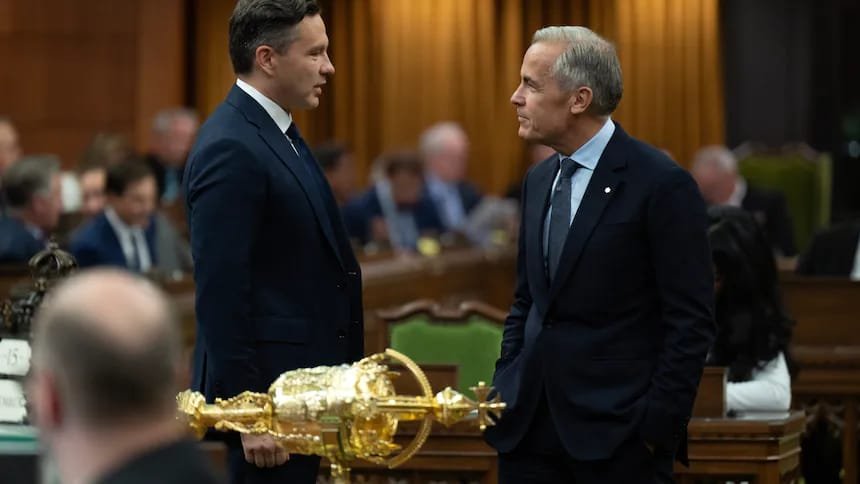
The emerging contrast between Mark Carney and Pierre Poilievre reveals two distinct visions of how Canada should manage its southern neighbor. Both understand the importance of the partnership, but their instincts—shaped by different professional backgrounds and political philosophies—suggest divergent paths. One favors strategic alignment with global priorities and institutional cooperation; the other emphasizes economic competitiveness and national leverage.
This difference is not merely stylistic. It reflects competing ideas about Canada’s place in a rapidly changing world.
Mark Carney: The Architect of Strategic Alignment
Mark Carney’s worldview is rooted in international institutions and global economic governance. As the former governor of both the Bank of Canada and the Bank of England, he has spent much of his career operating within multilateral frameworks. Unsurprisingly, his approach to the Canada–U.S. relationship appears to favor structured cooperation and shared global priorities, particularly on climate policy, financial regulation, and long-term economic transformation.
Under a Carney-style approach, Canada would likely deepen policy alignment with Washington in areas such as clean energy, supply chains, and financial stability. The logic is straightforward: modern economic competition is no longer simply about tariffs and trade deals—it is about who shapes the rules of emerging industries.
Consider the rapid expansion of U.S. industrial policy under legislation such as the Inflation Reduction Act. A Carney-influenced strategy would likely aim to position Canada as a strategic partner in North American green manufacturing, ensuring Canadian firms remain integrated in U.S.-led supply chains for batteries, critical minerals, and clean technology.
The advantage of this approach lies in stability and influence. By aligning with American economic transformation, Canada ensures it remains embedded within the continent’s most powerful market.
But the risk is equally clear: too much alignment can blur the line between partnership and dependency.
Pierre Poilievre: The Case for Economic Assertiveness
Pierre Poilievre represents a different philosophy—one rooted in domestic economic strength and political leverage. His approach suggests that Canada should not simply align with Washington’s priorities but instead compete and negotiate from a position of economic resilience.
At the core of Poilievre’s thinking is the idea that Canada must first fix its own economic fundamentals—energy production, regulatory efficiency, and productivity—before it can manage relations with the United States effectively.
Energy policy illustrates this divergence clearly. While Washington increasingly prioritizes clean energy transition, Poilievre’s perspective emphasizes Canada’s role as a major energy supplier. By expanding oil, gas, and resource exports, Canada could strengthen its bargaining power in North American markets.
In this model, the Canada–U.S. relationship becomes less about policy synchronization and more about strategic advantage. If Canada controls valuable resources and maintains a competitive economy, the argument goes, Washington will inevitably view Ottawa as an indispensable partner.
This approach resonates with voters who worry that Canada has become economically complacent.
However, it also carries risks. A strategy focused primarily on domestic competitiveness may underestimate the extent to which U.S. policy decisions can reshape continental markets regardless of Canadian preferences.
A Shifting Geopolitical Landscape
The debate between these two visions is unfolding at a moment when the Canada–U.S. relationship itself is evolving.
Global supply chains are fragmenting. The United States is increasingly prioritizing “friend-shoring”—keeping critical industries within trusted allies. Meanwhile, geopolitical competition with China is reshaping trade, technology, and security cooperation across the Western world.
For Canada, these changes present both opportunity and danger.
If Ottawa can position itself as the most reliable economic partner in North America, it stands to benefit enormously. But if Canadian policy drifts too far from American priorities—or becomes overly dependent on them—the country risks losing both influence and autonomy.
In this context, the Carney and Poilievre visions represent different responses to the same geopolitical reality.
One seeks stability through alignment.
The other seeks strength through independence.
The Real Challenge: Balancing Cooperation and Sovereignty
Ultimately, the debate should not be framed as a simple choice between Carney’s globalist pragmatism and Poilievre’s economic nationalism. Canada’s long-term success will likely require elements of both.
Canada cannot afford to distance itself from the United States; geography alone makes that impossible. But it also cannot afford to simply follow Washington’s lead on every major economic or strategic decision.
The real challenge is crafting a relationship that is deeply cooperative but strategically balanced.
This means aligning where interests overlap—such as defense, supply chains, and technological innovation—while maintaining the economic capacity to push back when Canadian priorities diverge.
Two Paths, One Strategic Imperative
The Carney and Poilievre visions ultimately represent two philosophies of Canadian statecraft.
Carney’s approach trusts in institutions, alliances, and coordinated economic transformation.
Poilievre’s approach trusts in markets, resources, and national competitiveness.
Both perspectives contain valuable insights, but neither alone offers a complete answer.
Canada’s relationship with the United States will always define its global role. The question is not whether Canada looks south—but how confidently it does so.
And in the coming political debates, that question may become the most important foreign policy discussion the country faces.
About the Author