










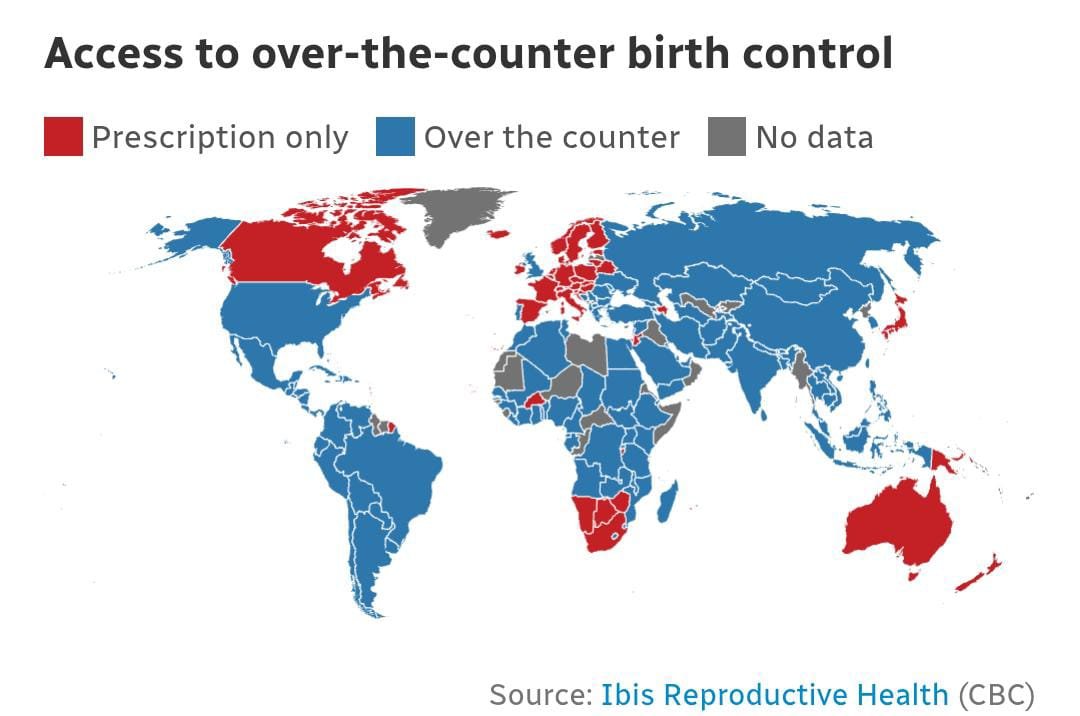
Canada likes to see itself as a global leader in health care, gender equity, and evidence-based policy. Yet when it comes to birth control access, the country is stuck in a paternalistic past. While dozens of countries allow people to obtain oral contraceptives directly from a pharmacist—or off the shelf entirely—Canadians still need a doctor’s permission to prevent pregnancy. This isn’t caution. It’s control disguised as care.
A Rule That Solves a Problem That No Longer Exists
Prescription requirements for birth control were introduced decades ago, when hormonal contraception was new, poorly understood, and legitimately required close medical oversight. That justification no longer holds.
Modern birth control pills are among the most studied medications in the world. Their risks are well known, clearly labeled, and—critically—screenable through simple questions about medical history. Countries like the UK, France, Mexico, and much of Southeast Asia have recognized this reality. Canada hasn’t.
Requiring a prescription today doesn’t improve safety. It creates friction. And in health care, friction always harms the people with the least power.

Gatekeeping as a Public Health Failure
Every extra step between a person and essential care reduces access. For birth control, those steps include finding a family doctor (increasingly difficult in Canada), booking an appointment, taking time off work or school, arranging childcare, and sometimes paying out of pocket. For rural residents, newcomers, young people, and low-income women, those barriers are often insurmountable.
The result is predictable: inconsistent use, gaps in coverage, and higher rates of unintended pregnancy. This isn’t theoretical. It’s observable. When access is easier, outcomes improve. When it’s harder, people pay the price—with their health, finances, and autonomy.
Canada’s prescription requirement doesn’t protect people from harm. It exposes them to it.
The Quiet Assumption Behind the Policy
At the core of this issue is an uncomfortable truth: Canada still treats contraception as something people must be supervised to use responsibly.
We trust individuals to buy nicotine, alcohol, emergency contraception, and countless medications with serious side effects—no prescription required. But birth control? That still demands oversight. The implication is subtle but clear: reproductive decision-making is uniquely suspect.
This isn’t about science. It’s about moral residue—an outdated discomfort with sexual autonomy, especially for women and people capable of pregnancy.

Pharmacists Are Already Doing the Work
Ironically, the infrastructure for change already exists. Pharmacists are trained medication experts. They routinely assess contraindications, manage drug interactions, and counsel patients on proper use. In some Canadian provinces, pharmacists can already prescribe for minor ailments and renew contraceptives—just not initiate them universally.
This half-measure approach exposes the inconsistency of the system. If pharmacists are qualified to renew birth control safely, they are qualified to provide it safely in the first place.
The resistance isn’t professional. It’s political.
Cost, Control, and the Myth of Neutral Policy
Policies are never neutral. By maintaining prescription-only status, Canada effectively outsources reproductive access to an overstretched physician system while pretending the resulting inequities are accidental.
They’re not.
Every delayed refill, every missed appointment, every person forced to ration pills or stop altogether is the foreseeable outcome of a policy choice. One that disproportionately affects young people, marginalized communities, and those without stable access to primary care.
This is how inequality hides in bureaucracy.

What Canada Is Really Afraid Of
Canada is not waiting for more evidence. The evidence is already global. What it’s waiting for is cultural comfort—permission to fully trust people with their own bodies.
Making birth control available without a prescription wouldn’t eliminate medical care. It would right-size it. Doctors would still play a crucial role for complex cases, long-acting contraception, and broader reproductive health. But basic access would no longer hinge on a gatekeeper.
That shift requires letting go of the idea that protection must come before autonomy.

A Modern Country Needs Modern Trust
If Canada wants to claim leadership in health equity and reproductive rights, it must stop clinging to policies that contradict both. Birth control is not experimental. It’s not dangerous in the way this system implies. And it’s not something people need permission to manage.
The question is no longer whether Canadians can be trusted with birth control.
The question is why the system still refuses to trust them.