The Middle East has entered one of its most volatile moments in decades. Israeli strikes on fuel depots in Tehran and a hotel in central Beirut come at the very moment Iran prepares to announce the successor to Supreme Leader Ayatollah Ali Khamenei, who was killed earlier in the conflict.
This timing is not accidental—it reveals a calculated strategy that goes beyond battlefield victories. What we are witnessing is not merely a military escalation but a strategic attempt to reshape the political architecture of the region.
War as a Tool of Political Disruption
Military strikes during a leadership transition are rarely coincidental. They are designed to exploit political uncertainty. Iran’s Assembly of Experts is reportedly close to announcing a new supreme leader, possibly a figure tied to the existing power structure.
Israel’s targeting of strategic infrastructure—particularly fuel depots used to sustain military operations—appears aimed at weakening Iran’s operational capacity at a moment when leadership cohesion is most fragile.
Historically, leadership transitions in authoritarian systems are moments of vulnerability. Internal factions compete for influence, and the state’s ability to respond to external threats can temporarily weaken. By striking now, Israel may be trying to ensure that Iran’s next leader inherits a weakened military and fractured strategic environment.
This is not just warfare—it is geopolitical timing.
Infrastructure Warfare: A Modern Battlefield
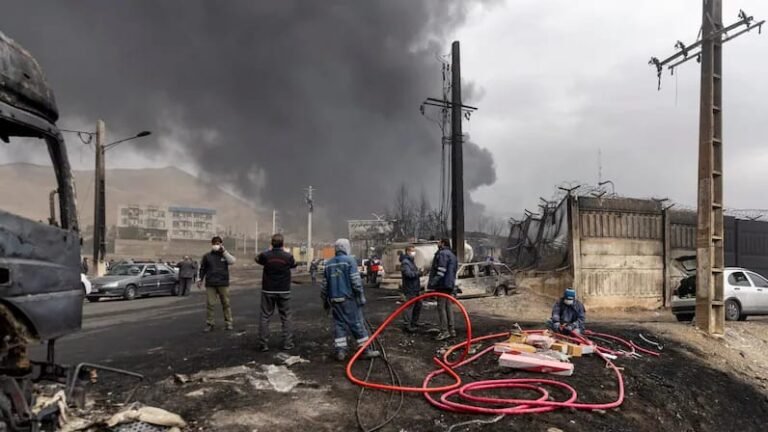
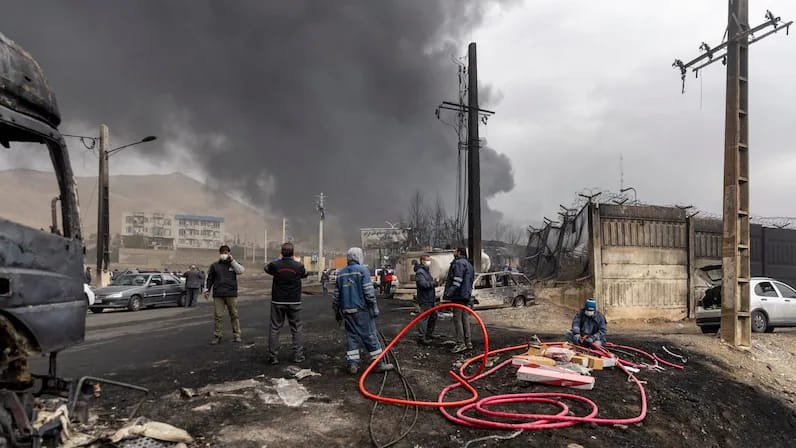
The attacks on Tehran’s fuel depots signal a shift toward infrastructure warfare. Modern conflicts increasingly target logistics and energy networks rather than purely military installations.
Fuel infrastructure is the lifeblood of modern warfare. Without fuel, aircraft remain grounded, armored vehicles stay immobile, and supply chains collapse. In the current conflict, Israeli officials have justified the strikes by arguing that these facilities support Iran’s military infrastructure.
But infrastructure warfare carries enormous risks. Civilian life is intertwined with energy systems. When depots burn, cities choke on smoke, industries halt, and ordinary citizens suffer the consequences.
This strategy may weaken an adversary, but it also deepens humanitarian crises and amplifies global instability.
Beirut: The Regionalization of the Conflict
The strike on a hotel in central Beirut highlights how rapidly this war is expanding beyond national borders. Israel claims the attack targeted Iranian-linked commanders connected to Hezbollah.
This development reflects a broader regional pattern: Iran rarely fights alone. Its influence stretches through allied groups across the Middle East—from Hezbollah in Lebanon to militias in Iraq and beyond.
As a result, any conflict with Iran quickly becomes a multi-front confrontation. The Beirut strike signals that Israel is prepared to confront not only Iran but the entire network of regional actors aligned with Tehran.
The danger is clear: a regional proxy war could transform into a full-scale Middle Eastern conflict.
The Leadership Question: Who Comes After Khamenei?
The looming announcement of Iran’s next supreme leader is perhaps the most consequential political decision in the Islamic Republic in decades. Reports suggest the selection process is already complete, though the identity has not been publicly revealed.
If the new leader emerges from the same ideological hardline circles that dominated under Khamenei, Israel and its allies may expect continuity rather than moderation.
But leadership transitions can also produce unexpected outcomes. Internal rivalries within Iran’s political and military elite could reshape the country’s strategic direction.
Ironically, external pressure and military strikes may strengthen hardliners who argue that compromise with the West is impossible.
A Dangerous Strategic Gamble
Israel’s strategy appears rooted in a bold assumption: that overwhelming pressure—military, political, and psychological—can weaken Iran’s regime and reshape regional power dynamics.
However, history offers cautionary lessons. External attacks often consolidate authoritarian regimes rather than destabilize them. Citizens rally around national identity, dissent becomes harder, and leaders gain justification for more aggressive policies.
Instead of weakening Iran, prolonged strikes could unify its factions and deepen its commitment to confrontation.
The World Cannot Ignore the Stakes
The conflict unfolding now is not merely another Middle Eastern flare-up. It sits at the intersection of nuclear concerns, energy security, and regional alliances.
Attacks on oil and fuel infrastructure could disrupt global energy markets. Escalation across Lebanon, the Gulf, and potentially other states risks dragging multiple powers into the conflict.
Most importantly, a war shaped around leadership change in Iran introduces an unpredictable variable. Political transitions are volatile even in stable countries—within a revolutionary regime under attack, they are explosive.
Conclusion: A War That Could Redefine the Region
The strikes on Tehran and Beirut are not isolated military actions—they are signals of a broader strategic campaign to shape the future of Iran and the Middle East.
Israel appears determined to weaken Iran before its next leader consolidates power. Iran, meanwhile, will likely frame the attacks as proof of external aggression requiring stronger resistance.
The result is a dangerous cycle: each move intended to deter the other instead escalates the conflict further.
In this environment, the real question is no longer who will succeed Khamenei.
The real question is whether the region can survive the geopolitical shockwaves that succession will unleash.
About the Author