








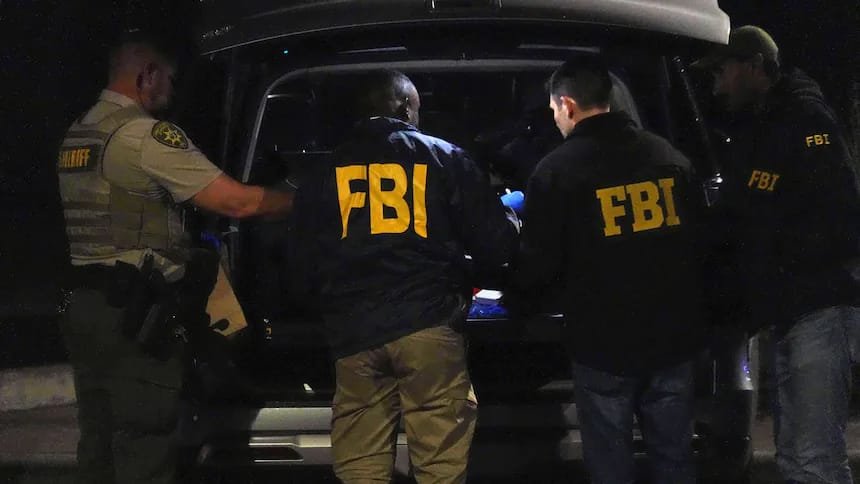
The report that the Federal Bureau of Investigation has recovered DNA from a glove found near the Guthrie residence is more than a procedural update in an investigation—it is a moment that exposes how modern justice now pivots on microscopic certainty. In an age where narratives travel faster than facts, forensic evidence has become both our shield against wrongful accusation and our most powerful prosecutorial weapon.
But DNA evidence is not just science. It is power. And how we handle that power defines the credibility of our justice system.
The Era of Forensic Dominance
We are living in what can only be described as the forensic era of criminal justice. Unlike eyewitness testimony—long known to be flawed—or circumstantial speculation, DNA evidence operates in the realm of probability and biological precision. It can narrow a suspect pool from thousands to one with astonishing accuracy.
However, its strength lies not in drama, but in discipline. DNA does not shout. It does not speculate. It quietly measures, compares, and concludes.
When the FBI reports that DNA has been recovered, it signals something crucial: the investigation has moved from theory to tangible evidence. That shift matters. Public opinion may form quickly, but prosecutors build cases on laboratory-confirmed data, not headlines.
Evidence Is Not a Verdict
It is tempting to treat the discovery of DNA as a near-conviction. That would be a mistake.
DNA on a glove does not automatically establish guilt. It establishes presence—or at minimum, contact. Context determines everything. Was the glove planted? Was it transferred indirectly? Was it contaminated? These questions are not technicalities; they are pillars of due process.
History reminds us that evidence mishandled or misinterpreted can distort justice. Conversely, DNA has also exonerated the wrongly convicted—dozens of cases overturned decades later because biological truth outlived human error.
The lesson is clear: forensic evidence is powerful, but it must be handled with humility.
The Public’s Hunger for Certainty
High-profile investigations trigger a predictable cycle—speculation, accusation, polarization. In the digital age, social media transforms partial updates into instant conclusions.
The DNA discovery near the Guthrie residence will undoubtedly intensify scrutiny and commentary. Yet justice cannot operate at the speed of trending hashtags. It must move at the speed of verification.
Real-world relevance is unmistakable. We have seen cases where premature judgments poisoned jury pools, damaged reputations, and complicated prosecutions. Responsible reporting and disciplined public response are not acts of restraint—they are acts of civic maturity.
The Double-Edged Sword of Scientific Authority
There is another dimension worth confronting: society’s almost religious faith in forensic science. DNA evidence is often perceived as infallible. But no system operated by humans is beyond error.
Laboratory mistakes, cross-contamination, or statistical misinterpretation can occur. The solution is not skepticism toward science—but rigorous transparency. Independent review, clear chain-of-custody documentation, and expert cross-examination are not obstacles to justice; they are safeguards of it.
When used properly, DNA is among the most reliable investigative tools ever developed. When used carelessly, it risks undermining the very system it seeks to strengthen.
Justice Must Be Methodical, Not Emotional
The discovery of DNA on a glove near the Guthrie residence may ultimately prove decisive—or it may simply become one piece in a much larger evidentiary puzzle. Either outcome reinforces a central truth: justice is cumulative.
Cases are built on patterns—motive, opportunity, corroboration, digital footprints, timelines, and forensic matches. DNA does not stand alone; it stands within a framework.
A confident justice system does not rush. It verifies. It cross-checks. It challenges its own assumptions before presenting conclusions to a court of law.
The Larger Implication
Beyond this single investigation lies a broader societal reality. Advances in forensic science have fundamentally shifted the balance between suspicion and proof. Criminal behavior leaves biological traces. Accountability, increasingly, is embedded in the very cells we shed without thinking.
That reality strengthens deterrence. But it also demands responsibility from investigators, media, and the public alike.
The glove near the Guthrie residence is not just an object—it is a test. A test of scientific rigor. A test of prosecutorial restraint. A test of whether society can separate evidence from emotion.
If handled correctly, the discovery will demonstrate the power of disciplined investigation in an age of noise. If mishandled, it will serve as yet another reminder that even the strongest evidence