A Quiet Statement With Loud Implications
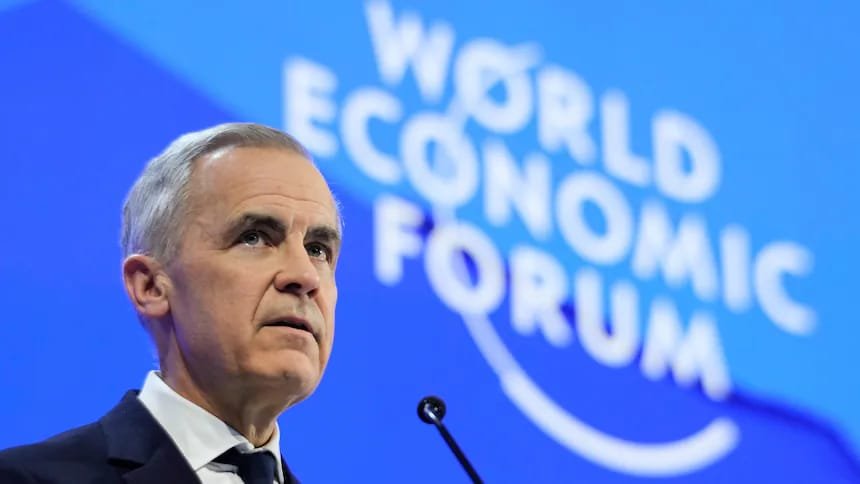
When Mark Carney speaks, markets move and policymakers listen. That is precisely why his recent signals—subtle in tone but expansive in implication—should not be dismissed as abstract musings from a technocrat. They point to something more consequential: a possible reorientation of Canada’s foreign policy away from its comfortable, middle-power orthodoxy and toward a harder-edged, interest-driven global posture. If taken seriously, Carney’s worldview suggests not a tweak, but a break.
The Old Model: Moralism Without Muscle
For decades, Canada’s foreign policy has rested on a familiar triad: multilateralism, moral leadership, and strategic ambiguity. Canada has preferred consensus to confrontation, institutions to power politics, and symbolism to leverage. This approach worked—when globalization was benign, U.S. leadership was stable, and international norms were broadly respected.
That world is gone.
In an era of great-power rivalry, weaponized trade, and climate-linked economic shocks, Canada’s traditional foreign policy has begun to look less principled and more evasive. It speaks the language of values while relying heavily on others to enforce them. The result is diminished influence: respected rhetorically, sidelined practically.
Carney’s Core Message: Power Now Flows Through Economics
Carney’s defining insight—shaped by his experience at the Bank of Canada, the Bank of England, and global financial institutions—is that economic systems are now geopolitical systems. Climate policy, supply chains, financial regulation, and currency stability are no longer technocratic domains; they are instruments of power.
This perspective implicitly challenges Canada’s long-standing separation of economics and diplomacy. Where traditional Canadian foreign policy treats trade, finance, and climate as cooperative spaces insulated from rivalry, Carney treats them as contested terrain. That alone is a radical shift.
If capital flows can destabilize governments, if climate standards can redraw industrial hierarchies, and if access to financial systems can punish adversaries, then foreign policy is no longer written only by diplomats—it is executed by regulators, central banks, and economic planners.
From “Helpful Fixer” to Strategic Actor
Canada has long branded itself as a “helpful fixer,” an honest broker without overt ambitions. Carney’s implied framework leaves little room for that identity. In his world, neutrality is not a virtue—it is a vulnerability.
A Carney-influenced foreign policy would likely prioritize:
Economic resilience over ideological openness
Strategic alignment over universal engagement
Long-term structural power over short-term diplomatic goodwill
This does not mean abandoning values. It means recognizing that values without leverage rarely survive contact with power. Real-world relevance matters here: countries that control financial plumbing, industrial standards, and climate finance set the rules. Those that don’t follow them.
Climate as Geopolitics, Not Charity
Perhaps the most disruptive implication of Carney’s thinking is how it reframes climate leadership. Traditionally, Canada has treated climate action as a moral obligation and reputational asset. Carney reframes it as a competitive strategy.
Green finance, carbon standards, and transition investment are not just about emissions—they determine which economies grow, which industries survive, and which countries dominate the next phase of globalization. Under this lens, Canada’s climate policy is inseparable from its foreign policy. Falling behind is not just environmentally costly; it is strategically negligent.
The Risk—and the Necessity—of Change
Critics will argue that this shift risks overreach, entanglement, and the loss of Canada’s distinct diplomatic voice. That concern is valid. A more assertive, economically strategic foreign policy demands competence, coordination, and political courage—qualities that are often unevenly distributed.
But the greater risk is inertia.
A foreign policy designed for a cooperative, rules-based order cannot function effectively in a fragmented, competitive one. Carney’s signal, whether intentional or not, forces a reckoning: Canada can no longer afford to confuse restraint with relevance.
Conclusion: An End, or an Evolution?
Is this the end of Canada’s traditional foreign policy? Not entirely—but it may be the end of its illusions.
Carney’s perspective does not reject Canadian values; it challenges the assumption that values alone generate influence. In doing so, it offers a sobering but necessary update to how power works in the 21st century. If Canada chooses to listen, it may finally move from being well-liked to being strategically consequential.
And in today’s world, that difference matters more than ever.
About the Author