








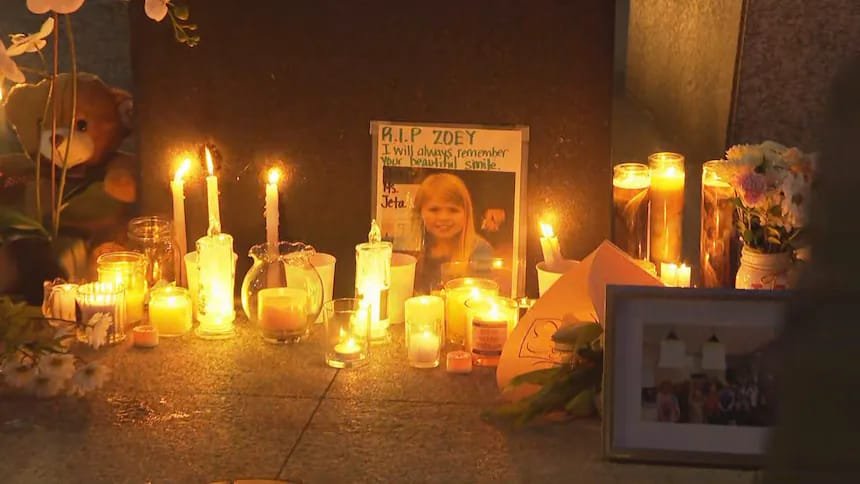
The vigil held in Langley for the victims of the mass shooting in Tumbler Ridge was more than a gathering of mourners — it was a moral statement. When a former local student’s name was spoken among the dead, the tragedy ceased to be distant news. It became personal. And that shift matters.
Mass shootings often register as statistics until they intersect with our own communities. This vigil reminded us that violence is not confined by geography. It travels through memory, through relationships, and through the invisible threads that bind one town to another.
When “Elsewhere” Becomes Home
Too often, Canadians comfort themselves with the idea that such violence happens “somewhere else.” But the moment a former student, a familiar name, or a remembered face is among the victims, that illusion collapses.
Communities like Langley are not isolated bubbles. Students graduate, families relocate, careers take people across provinces. What happens in Tumbler Ridge reverberates in Langley because people carry their histories with them. The vigil underscored a powerful truth: mobility does not sever belonging. A former student is never simply “former.” They remain part of the community’s story.
This interconnectedness is not sentimental — it is structural. Schools, sports teams, workplaces, and neighbourhoods form durable social networks. When violence strikes one node, the entire network feels the shock.
Vigils Are Not Passive — They Are Civic Acts
Critics sometimes dismiss vigils as symbolic gestures that accomplish little. That perspective is shortsighted.
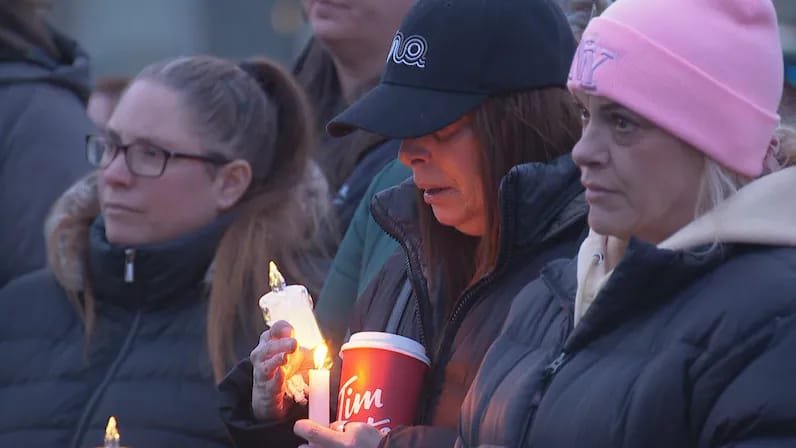
Public mourning is a form of civic resistance. It asserts that human life has value beyond headlines and beyond political debate. When people gather with candles, they are doing more than grieving; they are reinforcing communal norms — that violence is unacceptable, that victims will not be forgotten, and that indifference is not an option.
History shows that community responses shape long-term cultural attitudes. Collective mourning after tragedies has led to stronger advocacy for mental health resources, community policing reforms, and safer public spaces. Change rarely begins in legislative chambers; it begins in shared emotion crystallized into shared purpose.
The Responsibility of Small Communities
Smaller communities often believe they are insulated from large-scale violence. That belief can breed complacency. The reality is that no town is immune — whether geographically remote or densely populated.
The presence of a former local student among the victims should challenge communities to think beyond grief. It should prompt serious reflection on preparedness, youth support systems, and how warning signs are addressed. Tragedies are rarely spontaneous; they are often preceded by indicators that go unnoticed or unaddressed.

Communities must invest in:
- Accessible mental health services
- Strong school-community communication networks
- Programs that foster inclusion and belonging
- Early intervention frameworks for individuals in crisis
- Grief without reform is incomplete.
- Refusing Desensitization
Perhaps the most dangerous consequence of repeated mass shootings is desensitization. When tragedies become routine, outrage fades. The Langley vigil pushed back against that erosion of empathy.
By centering the memory of a former student, the community personalized the loss. Personalization disrupts apathy. It forces recognition that victims are not abstract figures but individuals with classmates, teachers, and unfinished ambitions.
In an age saturated with breaking news alerts, choosing to pause, gather, and remember is a radical act. It resists the algorithmic churn that turns tragedy into scrollable content.
A Call for Sustained Engagement
The true test of a vigil is what happens afterward.
If the gathering leads only to a fleeting emotional release, its impact will be limited. But if it strengthens community bonds, encourages civic participation, and inspires practical prevention efforts, it becomes transformative.
The loss of a former local student should compel long-term commitment — not just to remembrance, but to prevention. Communities must demand thoughtful public policy discussions around violence, mental health, and safety without descending into polarization. Constructive dialogue, not performative outrage, is what honours victims most effectively.
Conclusion: Memory as Mandate
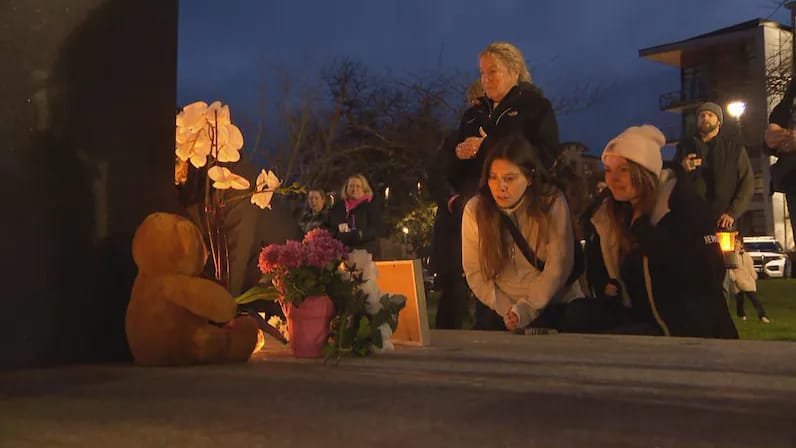
The vigil in Langley was not merely about mourning lives lost in Tumbler Ridge. It was about acknowledging that communities are interconnected and accountable to one another.
When we recognize that tragedy anywhere can become tragedy at home, we move from passive observers to engaged citizens. The name of a former student read aloud in candlelight is not only a memory — it is a mandate.
And whether communities choose to act on that mandate will define what such vigils ultimately mean.