









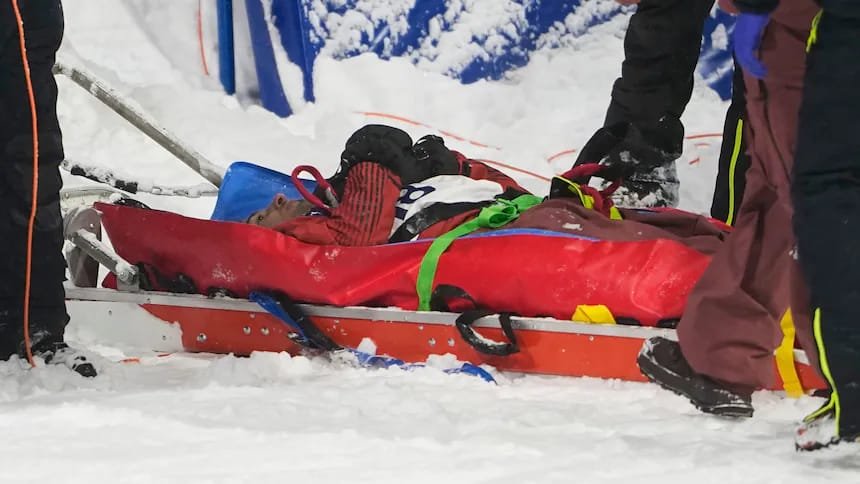
This Crash Should Make Us Uncomfortable
The news that Canadian snowboarder Mark McMorris has been released from hospital after a training crash is being framed as a victory. Headlines celebrate resilience, relief, and recovery. But treating this moment as a feel-good comeback story misses the point — and worse, it lets the sports world off the hook.
McMorris didn’t get hurt chasing recklessness. He was doing exactly what elite athletes are expected to do: train harder, push limits, and stay competitive in a sport that evolves faster than the safety systems around it. His hospital release is good news for him personally, but it should make the rest of us deeply uneasy.
Extreme Sports Reward Risk, Then Normalize the Damage
Snowboarding — especially at the elite level — is built on escalation. Bigger jumps. Faster rotations. Higher consequences. Athletes like McMorris don’t just compete against rivals; they compete against progression itself. What wowed judges five years ago is baseline today.
The problem? Risk has become normalized. Severe injuries are treated as occupational hazards rather than systemic failures. When a crash happens, the narrative shifts quickly to toughness and recovery instead of asking whether the structure of the sport is pushing athletes beyond reasonable margins.
McMorris’ crash isn’t an anomaly — it’s part of a pattern. Multiple Olympic-level snowboarders have suffered life-altering injuries in training environments that are largely unregulated compared to competition settings.
Training Is Now More Dangerous Than Competition
Here’s the uncomfortable truth: many of the most dangerous moments in modern snowboarding happen outside competitions. Training facilities chase innovation, but oversight lags behind. Courses are redesigned constantly, tricks are practiced at the edge of human capability, and the pressure to land never truly stops.
Athletes know that if they ease off, someone else won’t.
McMorris’ hospitalization highlights how little public attention is paid to training safety — despite the fact that this is where athletes spend the majority of their careers and take the greatest risks. Releasing him from hospital doesn’t resolve that imbalance.
Mental Toughness Is Being Used as a Shield
Sports culture loves to celebrate mental toughness. But that admiration often becomes a shield against accountability. When elite athletes are praised for pushing through pain, the implicit message is that caution equals weakness.
McMorris has built his career on courage and control. But no amount of mental strength can out-prepare physics. When crashes happen at this level, they are rarely about individual mistakes — they are about systems that reward danger more than sustainability.
Calling his release “a positive sign” is true, but incomplete. The real question is why this level of harm remains an acceptable cost of excellence.
If We Truly Respect Athletes, We Must Demand More
Mark McMorris’ survival and recovery matter. But respect for athletes isn’t measured by applause after injuries — it’s measured by prevention before them.
That means:
- Stronger safety standards in training environments
- Independent oversight of course design
- Honest conversations about competitive pressure and longevity
- A cultural shift away from glorifying near-fatal risk as heroism
McMorris doesn’t need to be framed as a lucky escape story. He should be the catalyst for asking why the margin between greatness and catastrophe keeps shrinking.
Recovery Shouldn’t Be the End of the Story
Mark McMorris leaving the hospital is good news — full stop. But if the sports world treats this as closure instead of a warning, it guarantees the next headline will sound eerily familiar.
Elite snowboarding doesn’t need less ambition. It needs more responsibility.
And that’s a conversation far more uncomfortable — and far more important — than celebrating discharge papers.