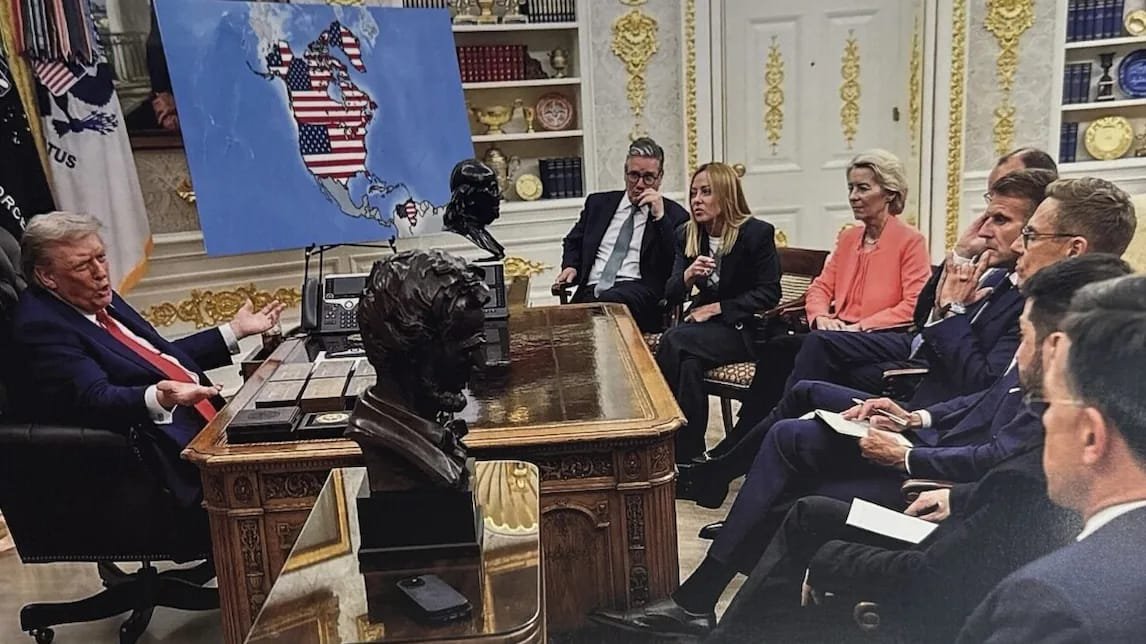
When Donald Trump posts an image showing Canada and Greenland folded into the United States, it’s tempting to dismiss it as provocation, satire, or digital trolling. That would be a mistake. In modern politics, imagery is not decoration — it is messaging. Maps, in particular, carry historical weight. They define borders, assert dominance, and communicate ambition without a single word. This image wasn’t about geography; it was about power.Symbolism as Strategy, Not AccidentTrump’s political brand has always relied on symbolism over nuance. The red hat, the wall, the slogans — all are visual shortcuts to complex ideas. A map that expands U.S. territory follows the same logic. It projects strength, dominance, and inevitability. Even if framed as humor, the message is clear: America first, America bigger, America unconstrained. In an era where attention is currency, ambiguity works in Trump’s favor. Supporters see confidence. Critics see arrogance. Both reactions keep him at the center of the conversation.
The Greenland Precedent Matters
This is not happening in a vacuum. Trump previously floated the idea of purchasing Greenland — an idea widely mocked but rooted in real geopolitical logic. Greenland is strategically valuable due to its location, resources, and role in Arctic security. By revisiting Greenland visually, alongside Canada, Trump is tapping into a broader narrative: the Arctic as the next frontier of global competition. What looks absurd on the surface mirrors real-world power struggles involving Russia, China, and NATO.
Why Canada’s Inclusion Is More Than Provocative
Including Canada is where the image crosses from geopolitical signaling into cultural messaging. Canada is not a rival state or disputed territory; it is a close ally with shared language, trade, and history. Absorbing it visually suggests a worldview where sovereignty is secondary to strength and proximity. This echoes a broader trend in strongman politics globally — where borders are seen as flexible if power allows it. History offers sobering examples of where that mindset leads.
Normalizing the Unthinkable
One of the most dangerous effects of such imagery is normalization. When extreme ideas are introduced casually — as jokes, memes, or “just posts” — they soften public resistance. What once seemed unthinkable becomes debatable, then discussable, then imaginable. This is not about literal annexation; it’s about shifting the Overton window. The image trains audiences to think of dominance as natural and expansion as bold rather than reckless.
The Real Audience Isn’t Abroad — It’s Domestic
Contrary to popular belief, this message isn’t aimed at Canada or Greenland. It’s aimed squarely at American voters who feel the U.S. has lost status, leverage, or respect. The map reassures them emotionally, not intellectually. It says: “We are still powerful. We still take what we want.” In that sense, the image functions as political therapy for a base fueled by grievance and nostalgia.
Why Dismissing It Is a Strategic Error
Laughing it off is easy — and dangerous. History shows that ambitious leaders often test reactions with symbolism before action. Even when no policy follows, the damage can still be real: strained alliances, weakened diplomatic trust, and a global perception of instability. Allies begin planning around unpredictability. Rivals exploit the chaos. Symbols, once released, cannot be recalled.
The Bigger Lesson About Modern Leadership
This episode reveals something deeper about leadership in the digital age. Power is no longer exercised only through treaties or troops, but through posts, images, and narratives. A single image can undermine decades of diplomacy or reinforce dangerous myths about entitlement and dominance. Leaders who understand this wield enormous influence — responsibly or recklessly.
Conclusion: Pay Attention to the Map
Trump’s map is not policy, but it is not meaningless. It reflects a worldview where strength overrides norms and spectacle replaces strategy. Whether one sees it as bravado or provocation, it deserves serious attention. Because when leaders redraw maps — even digitally — they are really redrawing how people think about power, borders, and the rules that keep the world from unraveling.
About the Author