









When Delay Becomes Policy
Federal records suggesting Ottawa stalled an airline fee meant to fund passenger complaints oversight are not just an administrative footnote—they reveal a deeper and recurring problem in Canadian governance. Delays of this kind are often framed as procedural caution or stakeholder consultation. In reality, they function as a quiet policy choice: one that prioritizes industry comfort over consumer rights while avoiding political accountability.
In aviation, where delays, cancellations, and service failures are not abstract inconveniences but routine disruptions to people’s lives, underfunding passenger protection mechanisms is not neutral. It actively shifts the burden from corporations to consumers.
The Illusion of Passenger Protection
Canada already has passenger rights on paper. The Air Passenger Protection Regulations (APPR) were introduced with much fanfare, promising accountability and fairness. Yet a right without enforcement is little more than a public relations exercise. The passenger complaints system—chronically backlogged and understaffed—has become a bottleneck rather than a safeguard.
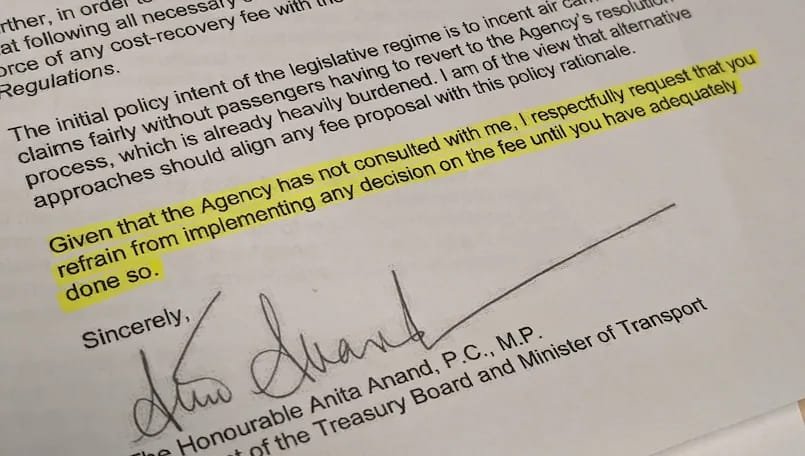
Stalling a fee designed to fund this system exposes a contradiction at the heart of Ottawa’s approach: it proclaims consumer protection while declining to resource it adequately. This creates a system where airlines face minimal consequences for non-compliance, while passengers wait months or even years for resolution.
Who Benefits From Inaction?
Government hesitation is rarely accidental. Every delayed fee is, in effect, a subsidy to airlines. By postponing costs associated with oversight, Ottawa shields carriers from financial responsibility for the problems they generate. This is particularly striking given that airlines already externalize many costs—missed connections, hotel stays, lost wages—onto passengers.
In most industries, complaints oversight is funded by the sector being regulated. Financial institutions pay for ombuds services. Professional bodies fund disciplinary systems. Aviation should be no different. When Ottawa delays such a mechanism, it signals that airline profitability is being weighed more heavily than passenger fairness.

Regulatory Capture in Plain Sight
The stalled fee also raises uncomfortable questions about regulatory capture. Airlines are sophisticated lobbyists with significant economic leverage. Passengers, by contrast, are fragmented, temporary stakeholders—powerful as a group but weak as individuals. When policy outcomes consistently favor industry convenience over consumer enforcement, it suggests that access, not merit, is shaping decisions.
This is not about malicious intent; it is about incentives. Governments are more responsive to organized, permanent interests than to dispersed, episodic ones. But recognizing this dynamic makes delay harder to excuse and more important to challenge.
The Cost of Delay Is Paid by the Public
The real-world impact of this stall is not theoretical. Complaints pile up. Confidence in the system erodes. Passengers stop filing claims altogether, effectively surrendering their rights. Airlines learn that even when rules exist, enforcement is slow enough to be tolerable.
Over time, this creates a two-tier system: travelers with time, legal knowledge, or resources can push through, while everyone else absorbs the loss. That outcome contradicts the very premise of public regulation—to level the playing field.
A Question of Political Will, Not Complexity
Ottawa does not lack the technical capacity to implement an airline oversight fee. The concept is straightforward, the models exist, and the need is well-documented. What’s missing is political urgency. Delay, in this context, is a choice to defer conflict with industry at the expense of passengers.
Strong governance is not measured by how carefully governments consult powerful stakeholders, but by whether they are willing to act when the public interest is clear.
Accountability Shouldn’t Be Optional
If federal records indeed show that Ottawa stalled this fee, the issue is larger than aviation. It reflects a broader pattern in which consumer protection is announced loudly and enforced quietly—if at all. Rights delayed are rights denied, and oversight unfunded is oversight in name only.
A functioning passenger complaints system is not an extra—it is the backbone of credibility in air travel regulation. Until Ottawa treats it that way, passengers will continue paying the price for government hesitation that masquerades as prudence.