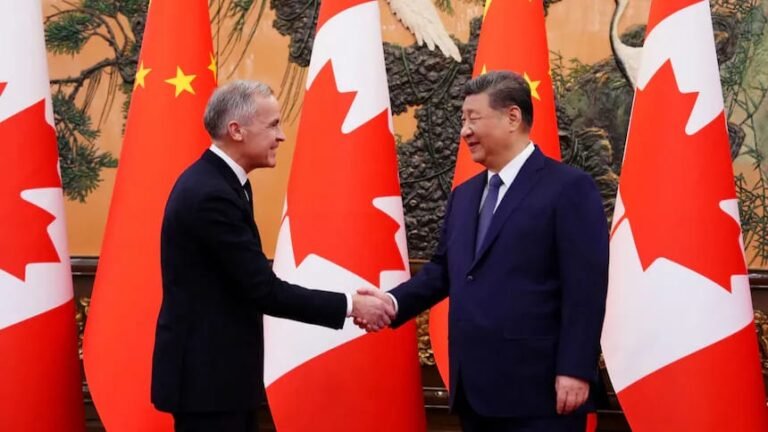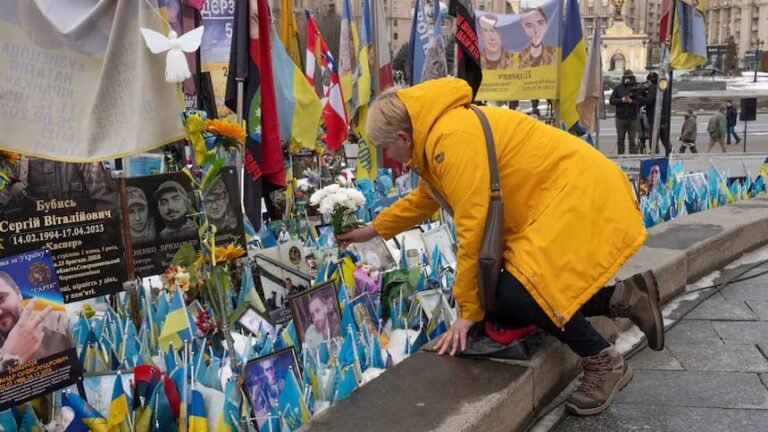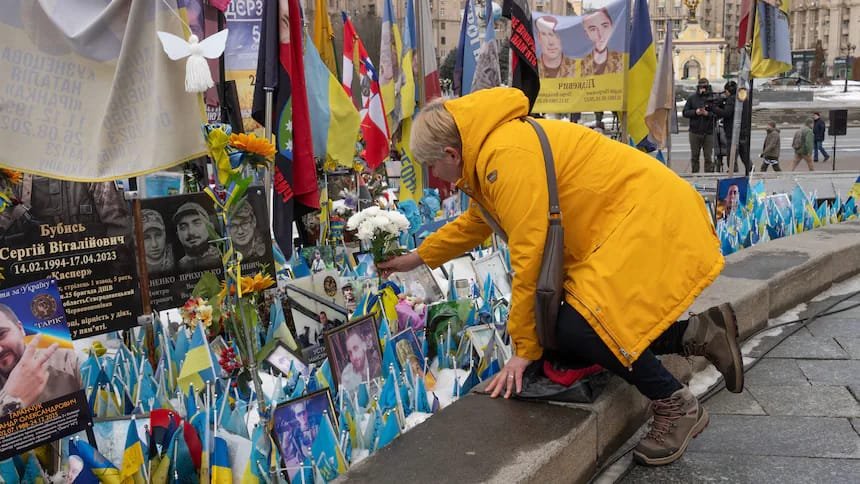
On the fourth anniversary of Russia’s full-scale invasion of Ukraine, Mark Carney pledged $2 billion in additional support and announced expanded sanctions against Russia. Predictably, critics questioned the cost. Supporters applauded the symbolism. But this moment is not about symbolism alone—it is about defining the kind of world Canada and its allies are willing to defend.
The Cost of Inaction Is Higher Than $2 Billion
Four years after the invasion of Ukraine, the war has reshaped global energy markets, food security, and military alliances. The idea that Canada can insulate itself from the consequences of aggression in Europe is naïve.
When authoritarian regimes redraw borders by force, the economic ripple effects are global. Grain shipments disrupted in the Black Sea raise food prices in Africa and the Middle East. Energy instability spikes costs for households thousands of miles away. Investor confidence erodes when geopolitical risk becomes normalized.
In that context, $2 billion is not a donation—it is a down payment on global stability. The real question is not whether Canada can afford it. It is whether Canada can afford not to act.
Sanctions Are Not Symbolic—They Are Strategic Pressure
Sanctions often attract skepticism. They are criticized as slow-moving or ineffective. But history shows sustained economic pressure can erode a regime’s long-term capacity to wage war.
Targeted financial restrictions, technology export bans, and asset freezes degrade military supply chains and limit access to advanced components. Even when they don’t produce immediate political capitulation, they constrain war-making power over time.
The Kremlin under Vladimir Putin has adapted—but adaptation is not immunity. Sanctions force difficult trade-offs inside the Russian economy: guns or growth, repression or reform, stability or stagnation.
Expanding sanctions on the war’s fourth anniversary sends a clear signal: fatigue will not translate into forgiveness.
The Fourth Anniversary Is a Political Test
Anniversaries matter in geopolitics. They test resolve. They measure endurance.
Four years into a protracted conflict, public attention drifts. Domestic priorities crowd out foreign commitments. Governments quietly scale back support under the guise of “realism.”
Carney’s pledge resists that drift. It communicates that time does not legitimize aggression. The longer a war continues, the more tempting it becomes to accept a frozen conflict as a permanent reality. But freezing injustice does not create peace—it cements instability.
Standing firm at the four-year mark reinforces a broader principle: borders are not negotiable through violence.
Why This Is Also About Canada’s Global Identity
Foreign policy is never purely external. It reflects national identity.
Canada has long positioned itself as a defender of multilateral order and rule-based diplomacy. Retreating now would signal that those commitments were conditional—dependent on convenience rather than conviction.
Moreover, NATO cohesion depends not only on military might but on political consistency. When middle powers demonstrate reliability, larger alliances gain credibility. When they hesitate, adversaries exploit divisions.
Carney’s move aligns Canada with the argument that security is collective. If democracies fail to defend each other under pressure, the deterrence architecture weakens everywhere—from Eastern Europe to the Indo-Pacific.
The Real Debate: Short-Term Strain vs. Long-Term Security
Opponents will argue that domestic economic pressures should take precedence. That funds should stay at home. That distant wars are not Canada’s burden.
But this framing misunderstands interconnected security. A destabilized Europe strains global trade. Prolonged war increases refugee flows and humanitarian costs. A victorious aggressor emboldens others.
Strategic foresight requires looking beyond election cycles. It demands recognizing that defending sovereignty abroad can prevent greater instability—and greater expense—later.
A Clear Message to the World
Ultimately, the $2 billion pledge and expanded sanctions communicate something larger than policy specifics. They declare that democratic states cannot be worn down simply by the passage of time.
On the fourth anniversary of invasion, the message is unmistakable: aggression will be resisted, endurance will be matched, and the rules that underpin international order still matter.
That stance is not reckless. It is responsible.
Because if the global community normalizes territorial conquest in the 21st century, the price of reversing that precedent will be far higher than $2 billion.
About the Author